


`json.loads()` / `json.load()` 有個 `strict` 參數,**預設 `True`**。它只管一件事:
**字串值裡能不能出現「未跳脫的控制字元」**——也就是「換行字元本身、tab 字元本身」
(按 Enter/Tab 直接打進去的那個字元),而不是 `\n`、`\t` 這種跳脫寫法。
json.loads(s, *, strict=True) # 預設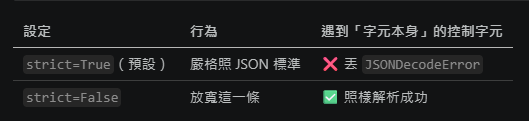
一個例子看懂
import json

# 字串值裡有「換行字元本身」(按 Enter 打進去的,不是 \n 跳脫寫法)→ 不合法 JSON
bad = '{"description": "line1\nline2"}'

json.loads(bad)                 # ❌ JSONDecodeError: Invalid control character...
json.loads(bad, strict=False)   # ✅ {'description': 'line1\nline2'}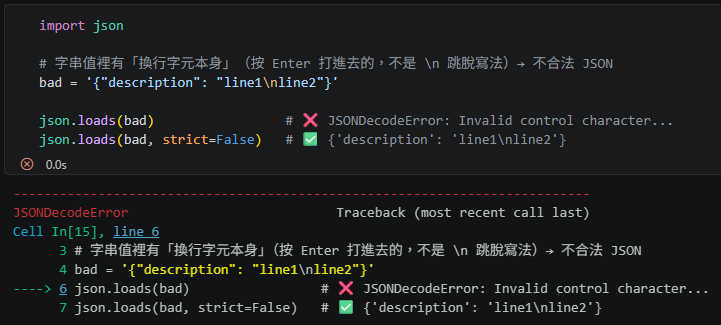
正確做法是把換行「跳脫」成 \n(兩個字元 \ + n),這樣連 strict=True 都沒問題:
good = '{"description": "line1\\nline2"}'   # 合法 JSON

json.loads(good)                # ✅ 不必 strict=False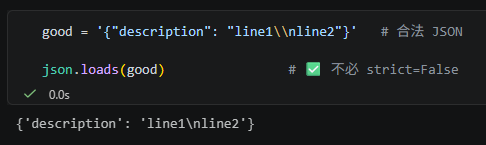
good與bad解析出來的結果完全一樣,差別只在「來源文字合不合法」。strict=False本質就是「寬容地把bad當good來讀」。
什麼是「控制字元」?
ASCII 0x00–0x1F 的不可見字元,常見:
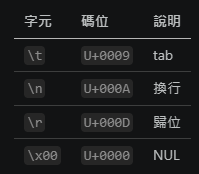
JSON 標準要求它們必須跳脫;直接塞真字元進字串值就是不合法。
三個關鍵觀念
strict只管控制字元——它不會修復其他錯誤(少括號、多逗號、key 沒引號、Extra data…)。那些在True/False下都一樣失敗。- 和
encoding無關——encoding是「bytes → 文字」的解碼(失敗是UnicodeDecodeError);strict是「文字 → JSON」的解析(失敗是JSONDecodeError)。兩個不同階段。 - 救回來的字元還在——
strict=False只是允許解析,不會刪字元。真的換行會變成字串裡的一個\n字元;不想要得自己.replace()。
建議用法
try:
    data = json.loads(text)                 # 先嚴格:乾淨檔正常過
except json.JSONDecodeError:
    data = json.loads(text, strict=False)   # 失敗才寬鬆:救含控制字元的髒檔
print("⚠️ loaded with strict=False") # 留個痕跡,知道這檔不乾淨為什麼不一開始就 strict=False? 先嚴格能讓「不乾淨的檔」被標記出來(利於追蹤品質);一律寬鬆會把問題悄悄吞掉, 而且對非控制字元的錯誤根本沒幫助。
一句話總結
strict=False = 「允許字串內含未跳脫的控制字元」。只放寬這一條,其餘 JSON 規則照舊。 能產出合法 JSON 最好,就完全用不到它。
推薦hahow線上學習python: https://igrape.net/30afN


![Python: 如何在pandas.read_csv() or pandas.read_excel() 中使用keep_default_na =False , na_values =[] 保留文件中的原始“NA”?](https://i2.wp.com/savingking.com.tw/wp-content/uploads/2024/05/20240530215737_0.png?quality=90&zoom=2&ssl=1&resize=350%2C233 "Python: 如何在pandas.read_csv() or pandas.read_excel() 中使用keep_default_na =False , na_values =[] 保留文件中的原始“NA”?")
![Python 表達式中的魔法:用海象運算子讓斷詞程式碼更乾淨 [w_clean for w in words if (w_clean:=w.lower().strip()) and w_clean not in STOPWORDS]](https://i2.wp.com/savingking.com.tw/wp-content/uploads/2026/02/20260210083748_0_a7d9bf.png?quality=90&zoom=2&ssl=1&resize=350%2C233 "Python 表達式中的魔法:用海象運算子讓斷詞程式碼更乾淨 [w_clean for w in words if (w_clean:=w.lower().strip()) and w_clean not in STOPWORDS]")


![Python-docx 圖片提取完全指南:從 rId 到二進位資料的探險rid ; part = doc.part.rels[rid].target_part #return part.blob if "ImagePart" in type(part).__name__ else None - 儲蓄保險王](https://savingking.com.tw/wp-content/uploads/2026/01/20260113135812_0_8fa645-520x245.png)

![Python 進階實戰:深入 Word 核心,挖出那一坨 BLOB (含自省 Debug 技巧, BLOB= Binary Large Object) ; part = doc.part.rels[rid].target_part ; return part.blob if "ImagePart" in type(part).__name__ else None - 儲蓄保險王](https://savingking.com.tw/wp-content/uploads/2026/01/20260126111046_0_cd8751-520x245.png)
近期留言