

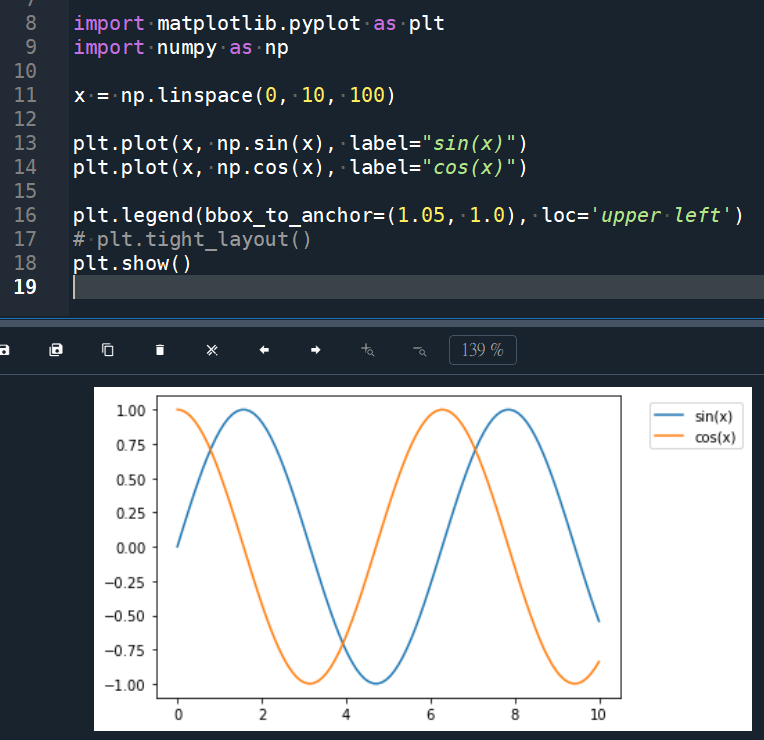
import matplotlib.pyplot as plt
import numpy as np
x = np.linspace(0, 10, 100)
plt.plot(x, np.sin(x), label="sin(x)")
plt.plot(x, np.cos(x), label="cos(x)")
plt.legend(bbox_to_anchor=(1.05, 1.0), loc='upper left')
# plt.tight_layout()
plt.show()
plt.tight_layout()
沒加這一行
Spyder沒出現裁切圖例的狀況
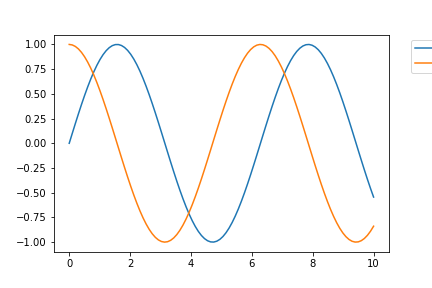
但是 plt.savefig(“bbox_to_anchor.png”)
儲存的檔案出現被裁切的狀況:
import matplotlib.pyplot as plt
import numpy as np
x = np.linspace(0, 10, 100)
plt.plot(x, np.sin(x), label="sin(x)")
plt.plot(x, np.cos(x), label="cos(x)")
lg = plt.legend(bbox_to_anchor=(1.05, 1.0), loc='upper left')
plt.savefig('example.png',
dpi=300,
format='png',
bbox_extra_artists=(lg,),
bbox_inches='tight')
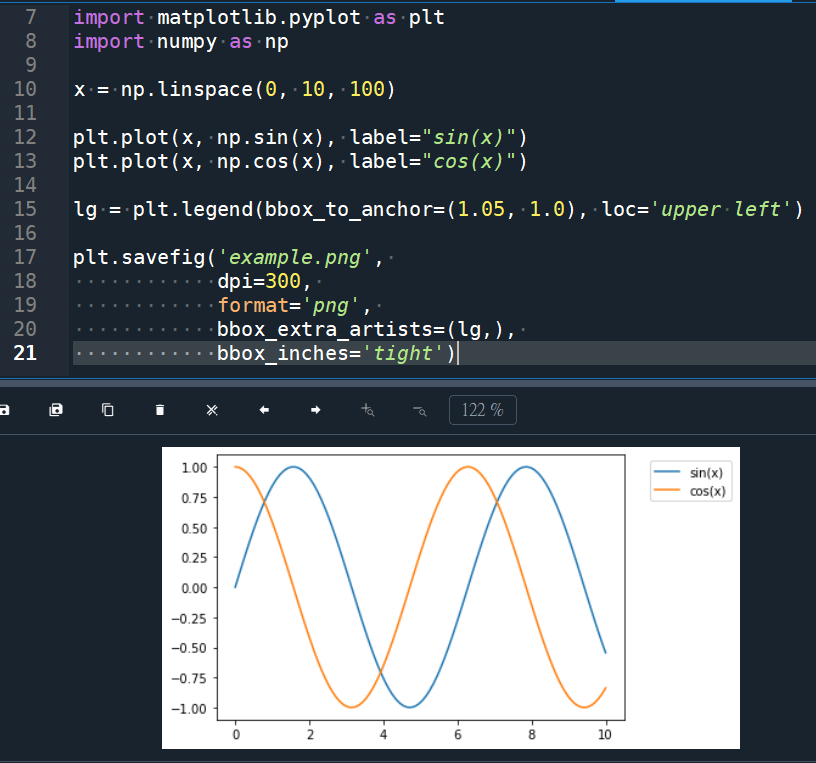
bbox_extra_artists 指定 Artist 的列表,該列表在計算緊湊 bbox 時會考慮在內。
如果將 bbox_inches 設定為 tight,它將計算出圖中的緊湊型 bbox。
推薦hahow線上學習python: https://igrape.net/30afN
![Python: pandas.DataFrame()處理雙維度資料,dict跟2D list轉為DataFrame有何差別?如何用index及columns屬性客製化index跟欄位名稱?df.index = [“一”,”二”,”三”,”四”] ; df.columns = 使用.head(n) ; .tail(m) ;取首n列,尾m列; .at[index,欄位名稱] 取單一資料 ; .iat[index,欄位順序] 取單一資料 ; .loc[index,欄位名稱] 取資料 ; .iloc[index,欄位順序];df.iloc[ [0,1],[0,2]])取資料 ; df.iloc[ 0:3,0:2]切片 Python: pandas.DataFrame()處理雙維度資料,dict跟2D list轉為DataFrame有何差別?如何用index及columns屬性客製化index跟欄位名稱?df.index = [“一”,”二”,”三”,”四”] ; df.columns = 使用.head(n) ; .tail(m) ;取首n列,尾m列; .at[index,欄位名稱] 取單一資料 ; .iat[index,欄位順序] 取單一資料 ; .loc[index,欄位名稱] 取資料 ; .iloc[index,欄位順序];df.iloc[ [0,1],[0,2]])取資料 ; df.iloc[ 0:3,0:2]切片](https://i2.wp.com/savingking.com.tw/wp-content/uploads/2022/11/20221111093547_79.png?quality=90&zoom=2&ssl=1&resize=350%2C233)

![Python: 如何創建多層column name的pandas.DataFrame? df = pd.read_csv (‘data.csv’, header=[0, 1], sep=”,”) ; col = pd .MultiIndex .from_arrays( aryCol ) Python: 如何創建多層column name的pandas.DataFrame? df = pd.read_csv (‘data.csv’, header=[0, 1], sep=”,”) ; col = pd .MultiIndex .from_arrays( aryCol )](https://i1.wp.com/savingking.com.tw/wp-content/uploads/2023/03/20230314164119_32.png?quality=90&zoom=2&ssl=1&resize=350%2C233)


![Python, typing: 函數庫規格標註; def addTest(x:float, y:float) -> float: List[資料型態] Set[資料型態] Tuple[資料型態] Dict[str,value的資料型態] Union[資料型態1, 資料型態2] ,函式若有多個輸出值,其實是輸出一個tuple Python, typing: 函數庫規格標註; def addTest(x:float, y:float) -> float: List[資料型態] Set[資料型態] Tuple[資料型態] Dict[str,value的資料型態] Union[資料型態1, 資料型態2] ,函式若有多個輸出值,其實是輸出一個tuple](https://i1.wp.com/savingking.com.tw/wp-content/uploads/2022/09/20220907154601_86.png?quality=90&zoom=2&ssl=1&resize=350%2C233)


近期留言