


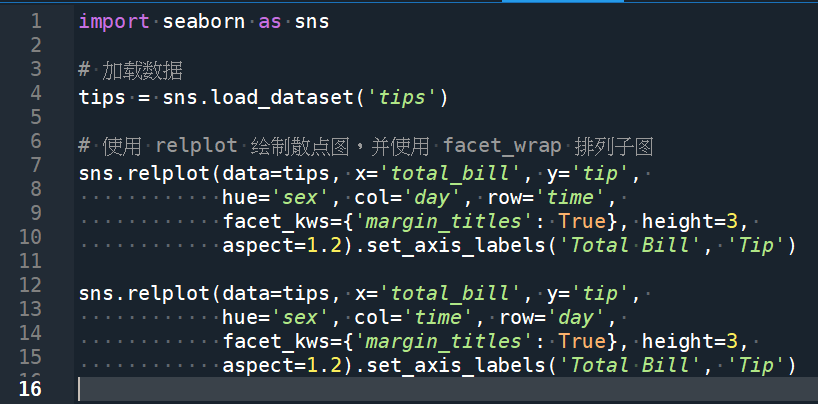
import seaborn as sns
# 加载数据
tips = sns.load_dataset(‘tips’)
# 使用 relplot 绘制散点图,并使用 facet_wrap 排列子图
sns.relplot(data=tips, x=’total_bill’, y=’tip’,
hue=’sex’, col=’day’, row=’time’,
facet_kws={‘margin_titles’: True}, height=3,
aspect=1.2).set_axis_labels(‘Total Bill’, ‘Tip’)
sns.relplot(data=tips, x=’total_bill’, y=’tip’,
hue=’sex’, col=’time’, row=’day’,
facet_kws={‘margin_titles’: True}, height=3,
aspect=1.2).set_axis_labels(‘Total Bill’, ‘Tip’)
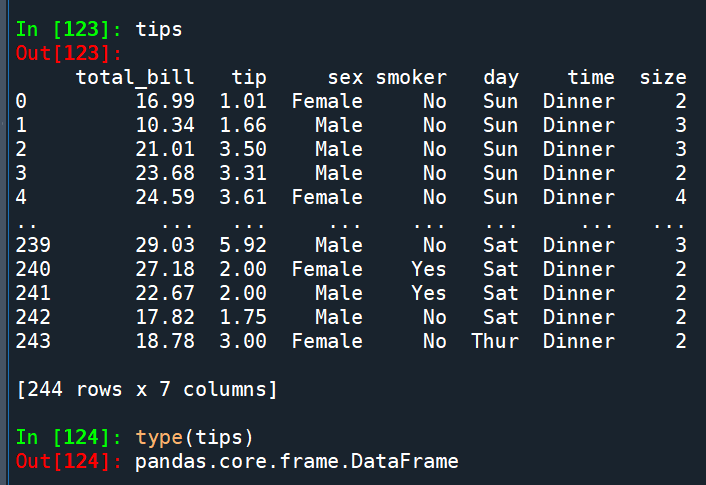
tips(pandas.core.frame.DataFrame):
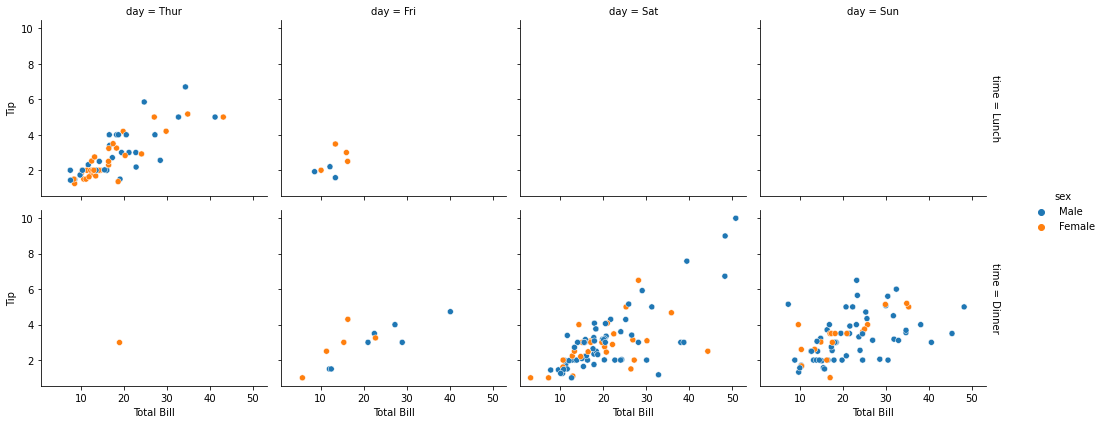
col=’day’, row=’time’
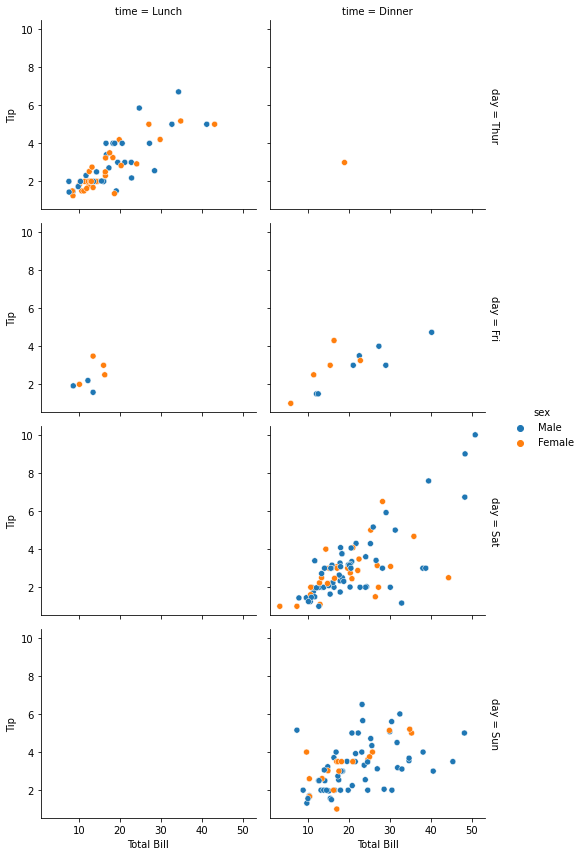
col=’time’, row=’day’
推薦hahow線上學習python: https://igrape.net/30afN


![Python: Regular Expression 正規表示法 正則表達式 import re ; pattn = “[\d]{4}\/[01][\d]\/[0123][\d] [\d]{6}” ; match = re .search (pattn,text) .group()](https://i1.wp.com/savingking.com.tw/wp-content/uploads/2022/09/20220901154435_19.png?quality=90&zoom=2&ssl=1&resize=350%2C233 "Python: Regular Expression 正規表示法 正則表達式 import re ; pattn = “[\d]{4}\/[01][\d]\/[0123][\d] [\d]{6}” ; match = re .search (pattn,text) .group()")



近期留言