

在 Python 中,關鍵字參數的區分大小寫是預設行為,無法直接更改。然而,您可以在函數中處理關鍵字參數時,將其轉換為統一的大小寫形式,以達到不區分大小寫的效果。
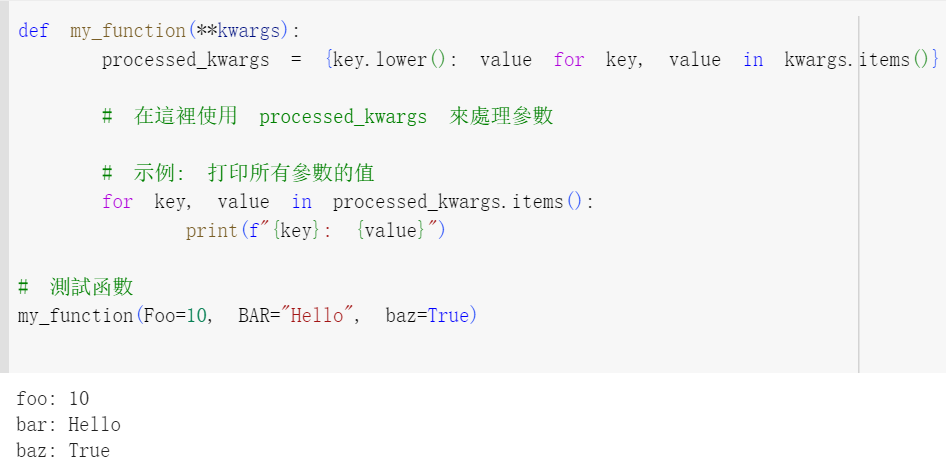
以下是一個示例,展示了如何在函數中處理不區分大小寫的關鍵字參數:
def my_function(**kwargs):
processed_kwargs = {key.lower(): value for key, value in kwargs.items()}
# 在這裡使用 processed_kwargs 來處理參數
# 示例: 打印所有參數的值
for key, value in processed_kwargs.items():
print(f"{key}: {value}")
# 測試函數
my_function(Foo=10, BAR="Hello", baz=True)輸出結果:

#Foo , BAR統一變成小寫
推薦hahow線上學習python: https://igrape.net/30afN
![Python提取2D array的一部份資料; import numpy; a[1: , 2:] ; a[1:-1 , 2:-1] Python提取2D array的一部份資料; import numpy; a[1: , 2:] ; a[1:-1 , 2:-1]](https://i0.wp.com/savingking.com.tw/wp-content/uploads/2022/09/20220906122441_97.png?quality=90&zoom=2&ssl=1&resize=350%2C233)


![Python 如何用pandas.Series.nsmallest() 找到n個與target差距最小的index?再從中找到距離idxmax最近的index?避免誤抓sidelobes的index? targetIdx = (serMean-target_value).abs().nsmallest(n).index.tolist() ;Series切片: .loc[標籤名1:標籤名2] (會含標籤名2) ; .iloc[位置1:位置2] (不含位置2) Python 如何用pandas.Series.nsmallest() 找到n個與target差距最小的index?再從中找到距離idxmax最近的index?避免誤抓sidelobes的index? targetIdx = (serMean-target_value).abs().nsmallest(n).index.tolist() ;Series切片: .loc[標籤名1:標籤名2] (會含標籤名2) ; .iloc[位置1:位置2] (不含位置2)](https://i1.wp.com/savingking.com.tw/wp-content/uploads/2023/02/20230222082954_53.png?quality=90&zoom=2&ssl=1&resize=350%2C233)

![Python: pandas.DataFrame如何移除所有空白列?pandas.isna( df_raw[0] ).tolist() ; df_drop0 = df_raw.drop(nanIdx,axis=0).reset_index(drop=True) Python: pandas.DataFrame如何移除所有空白列?pandas.isna( df_raw[0] ).tolist() ; df_drop0 = df_raw.drop(nanIdx,axis=0).reset_index(drop=True)](https://i0.wp.com/savingking.com.tw/wp-content/uploads/2022/12/20221206184635_4.png?quality=90&zoom=2&ssl=1&resize=350%2C233)
![Python四種型態增加元素 list.append(元素), tuple = tuple + (元素, ), set.add(元素), dict[key]=value Python四種型態增加元素 list.append(元素), tuple = tuple + (元素, ), set.add(元素), dict[key]=value](https://i1.wp.com/savingking.com.tw/wp-content/uploads/2022/05/20220513083711_22.png?quality=90&zoom=2&ssl=1&resize=350%2C233)


近期留言